
Guide
Gas or charcoal? An honest comparison
Few barbecue questions are debated as passionately. Yet there's no single right answer for everyone – just the right one for your situation. We compare flavour, effort, costs and everyday practicality.
Updated 7 min readEditorial team wogrill.de
The short version
If you often grill spontaneously on weekdays, are short of time and value precise temperature control, a gas barbecue is usually the better choice. If barbecuing is a ritual for you, you enjoy playing with the embers and love a smoky flavour, you'll be happier with charcoal. If you can only grill on a balcony, you'll often end up with an electric grill, because smoke and gas bottles frequently cause problems there.
Many barbecue fans end up with both: a gas barbecue for everyday use and a kettle or smoker for the weekend. If you only want to buy one appliance, the following criteria will help you decide.
Flavour: how big is the difference really?
The typical barbecue flavour comes mainly from browning on the surface (the Maillard reaction) and from fat and meat juices dripping onto hot surfaces and vaporising. Both happen equally on gas and charcoal grills, provided the grill is hot enough. With short cooking – sausages, steaks, vegetables – the difference is therefore smaller than many people think.
It becomes more noticeable with longer cooking times under the lid. Charcoal, and wood in particular, release smoke compounds that settle on the food. If you want spare ribs, pulled pork or whole chickens with a smoky flavour, charcoal or a smoker serves you better. On a gas barbecue you can help things along with a smoker box and wood chips, but the result stays milder.
Heat-up time and spontaneity
A gas barbecue reaches temperature in about ten minutes. You turn the knob, ignite and can get started shortly afterwards. When you're done, you turn off the gas – that's it.
With a charcoal grill and a chimney starter, it takes around 15 to 25 minutes until the charcoal is fully lit. Afterwards the embers have to be spread out, later cooled down completely and the ash disposed of. For an after-work barbecue that's noticeably more effort; at the weekend, many people see it as part of the experience.
Temperature control
On a gas barbecue you control each burner individually. You can set up zones for direct and indirect grilling in seconds, and the temperature stays stable as long as there's gas in the bottle. That makes it particularly beginner-friendly.
With charcoal, you control the heat via the amount of charcoal, its distribution, the grate height and the vents. That takes practice but gives you plenty of scope: very high temperatures directly over the embers, and – with a kettle or smoker – hours of low temperatures for low & slow.
Costs: purchase and running
Charcoal grills are usually cheaper to buy. You can get simple models for little money, and decent kettles cost in the low to mid hundreds. Gas barbecues with three or four burners often start in the low hundreds; well-made models with stainless steel burners and cast iron grates cost considerably more.
In terms of running costs, the two are often closer than you might think. Per barbecue evening you'll use several kilograms of charcoal or briquettes with charcoal, and part of a propane bottle with gas. How much that costs depends heavily on grill size, duration and temperature. With gas, there's also the one-off cost of a deposit bottle or buying your own bottle.
Popular gas barbecues
Ad All products linked with "View offer" are commission (affiliate) links: if you buy through them, we earn a commission – the price stays the same for you. As an Amazon Associate and eBay Partner Network affiliate we earn from qualifying purchases. Learn more
 Ad
Ad Ad
Ad Ad
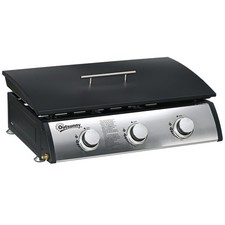
AdTepro 3313 Tischgasgrill Chicago
 Ad
AdGasgrill, Tischgrill BBQ mit 3 Brennern, Tischgasgrill mit Schlauch, Deckel
Cleaning and care
On a gas barbecue, you burn the grate clean on full for a short while after grilling and brush it off. It's important to empty the grease tray regularly and clean the burners and flame tamers now and then. A grease fire in an overfull tray is one of the most common gas barbecue accidents.
A charcoal grill produces ash, which may only be disposed of once it has cooled completely. Ash absorbs moisture and promotes rust, so you shouldn't leave it in the grill for weeks. On the plus side, the technology is simple: there are no burners, valves or hoses to age.
Safety: what to bear in mind with both
Both types of grill belong outdoors only. Glowing charcoal produces large amounts of carbon monoxide, even when there's hardly any smoke visible. The gas is odourless and can be fatal in enclosed rooms, garages, tents or conservatories. Never bring a seemingly extinguished charcoal grill indoors to cool down either.
With a gas barbecue you also have the gas bottle, hose and regulator to consider. Check the connections with leak-detection spray or soapy water after every bottle change, replace porous hoses and never store bottles in cellars or other rooms below ground level, because escaping propane collects at floor level. With a charcoal grill, accelerants such as methylated spirits are off-limits.
- Only grill outdoors, never in a garage, tent or conservatory
- Only light charcoal with a chimney starter or solid firelighters
- Check gas connections for leaks after every bottle change
- Empty the grease tray regularly
- Keep children and pets away from the hot grill
Balcony, garden, on the go: where you grill matters
In your own garden you have a free choice, as long as you don't bother your neighbours excessively with smoke. On the balcony of a rented flat it's a different story: charcoal is often ruled out by the house rules or tenancy agreement because of the smoke, and sometimes gas bottles are too. An electric grill is often the only uncomplicated option there.
For camping and picnics, both worlds exist in small form: folding charcoal grills and portable gas grills with cartridges. Campsites often only allow gas or electric grills.
Kettle barbecues for charcoal fans
Ad All products linked with "View offer" are commission (affiliate) links: if you buy through them, we earn a commission – the price stays the same for you. As an Amazon Associate and eBay Partner Network affiliate we earn from qualifying purchases. Learn more
 Ad−21%
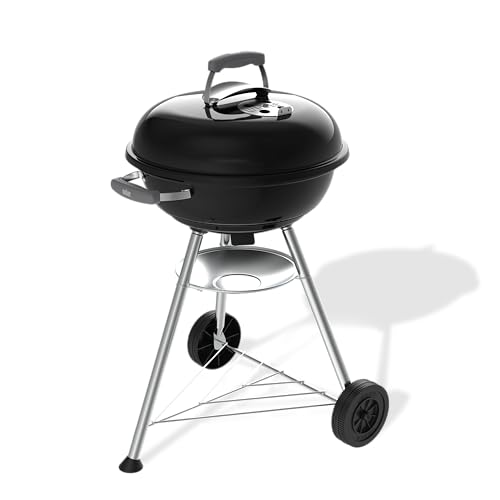
Weber Compact Kettle Holzkohlegrill 47 cm mit Stand und Rädern …
 Ad
AdBBQ-Toro Kugelgrill Ø 57 cm | Grillfläche Ø 54,5 cm …
 Ad
AdKamado Grill Keramikgrill Holzkohlegrill Smoker Kugelgrill Grill-Ei …
 Ad
AdKugelgrill Emaille Holzkohlegrill Mit Deckel Rädern und Unterkorb …
What about combination grills and pellets?
Combination grills unite a gas barbecue with a charcoal tray in one housing. That sounds like the best of both worlds, but also means compromises in size and build quality. If you really want to use both regularly, two specialised appliances are often the better option.
Pellet grills burn wood pellets, which an auger feeds in automatically. They combine wood flavour with simple temperature control, but need electricity and tend to be expensive to buy.
Three common misconceptions
First: "You can't grill properly with gas." Modern gas barbecues with cast iron grates and a high-heat zone produce strong roasted flavours, and indirect cooking works without any problems. Second: "Charcoal is less healthy than gas." What matters most is that no fat drips into the embers and the food doesn't char – that applies to both types. Grill trays, an indirect zone and cutting off burnt bits help here. Third: "An expensive grill automatically makes better food." A simple grill used well beats a luxury appliance used badly, because temperature, cooking time and the food itself matter more than features.
Five questions to help you decide
If you're still unsure, answer these questions honestly. A clear tendency usually emerges.
- Do you tend to grill spontaneously on weekdays (gas) or deliberately at the weekend (charcoal)?
- Where will the grill stand: garden, patio or rented balcony (more likely electric)?
- Do you also want to cook slowly and smoke (charcoal, kettle, smoker)?
- How important is quick cleaning without ash to you (gas, electric)?
- What budget do you have for the grill and accessories?
Our verdict
The gas barbecue is the pragmatic all-rounder for anyone who wants to grill often, quickly and without fuss. The charcoal grill is the choice for connoisseurs who appreciate a smoky flavour and enjoy working with fire. Both can deliver excellent results – what counts in the end is good food, the right temperature and a grill that suits your everyday life. Use our comparison pages to put models, features and price histories side by side.
FAQ
Does food from a charcoal grill taste better?
With short cooking times the difference is small, because roasted flavours develop on both grills. With long cooking times under the lid, charcoal gives more smoky flavour.
Which is cheaper to run?
That depends heavily on grill size and use. Per barbecue evening, both are often in a similar range.
Which grill is better for beginners?
A gas barbecue is more forgiving and easier to control. But if you enjoy tinkering and have time, you'll learn quickly with a kettle too.
Can I smoke food on a gas barbecue?
Yes, with a smoker box and wood chips over one burner. The flavour is milder than with charcoal or in a smoker.
What's best for a balcony?
Usually an electric grill, because it produces hardly any smoke and needs no gas bottle. Your tenancy agreement and house rules are binding, though.